One Set, Ten Compositions: Balance and Rhythm in Nail Art
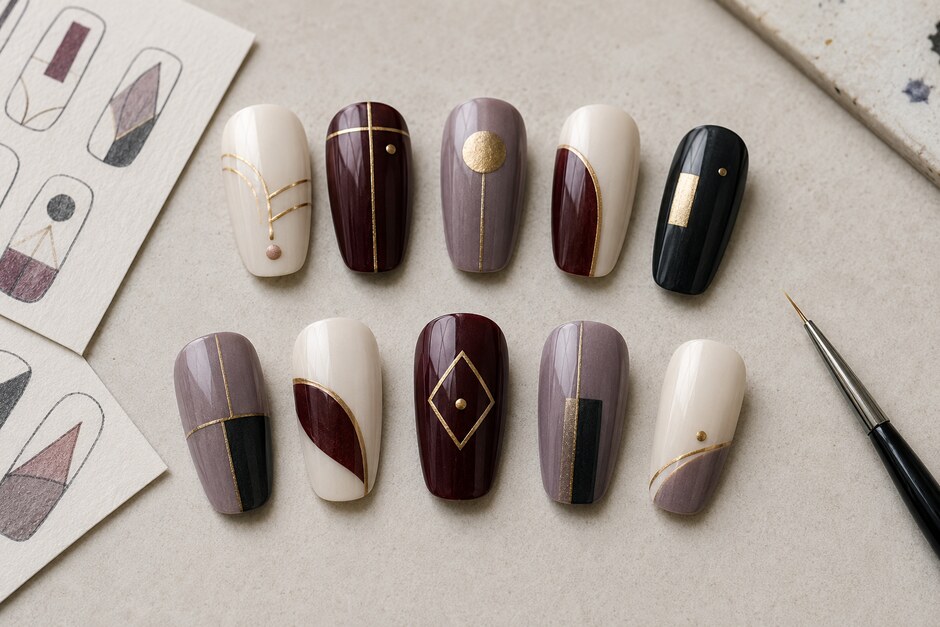
A nail-art set has two levels of composition. Each nail is a tiny vertical canvas, but all ten nails also form one wider image. A detail can look balanced on a single tip and still feel misplaced when the hands are viewed together. Strong sets manage both scales: the internal design of each nail and the rhythm created from finger to finger.
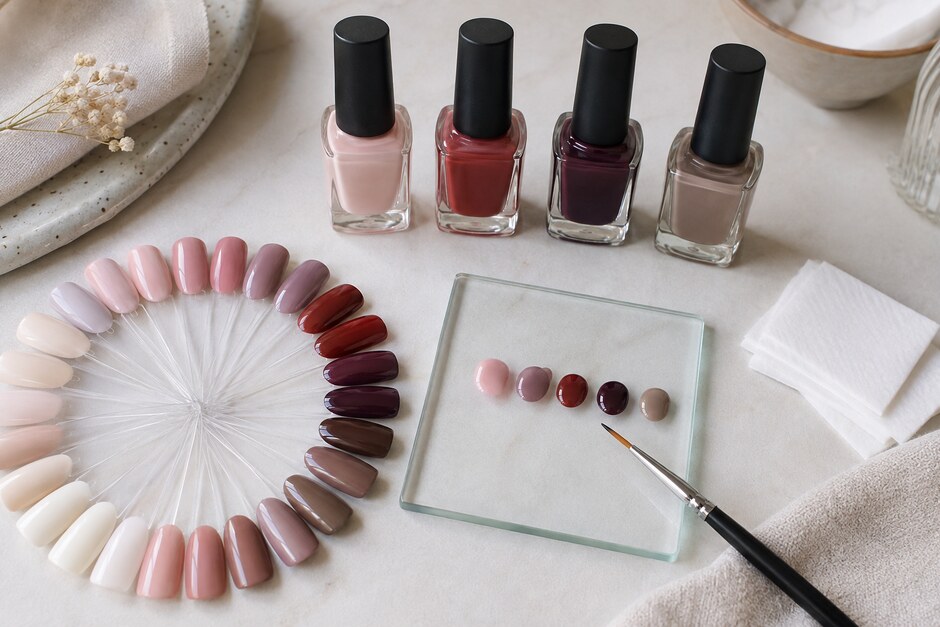
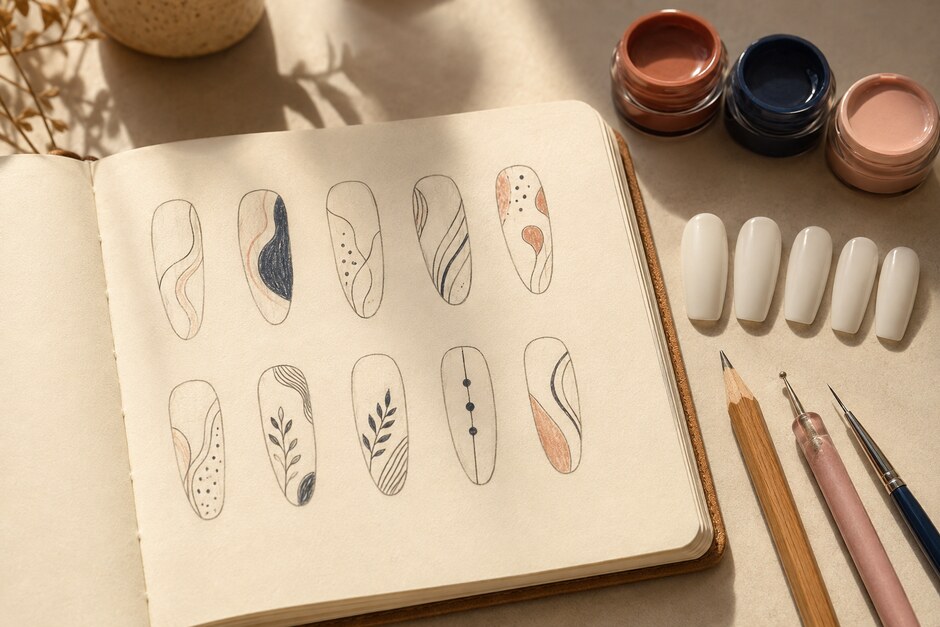
Plan on display tips or a paper template first. Composition is easier to judge when every nail can be moved without removing product.
Start with the ten-nail silhouette
Arrange ten blank tips in their approximate finger order. Their widths and lengths already create variation. A motif that fits the thumb may overwhelm the little finger, while a delicate line designed for the little finger can disappear on the thumb.
Mark three visual roles: quiet nails, supporting nails, and focal nails. A practical starting ratio is four quiet, four supporting, and two focal. The numbers can change, but naming the roles prevents equal detail everywhere.
Use value before decorative technique
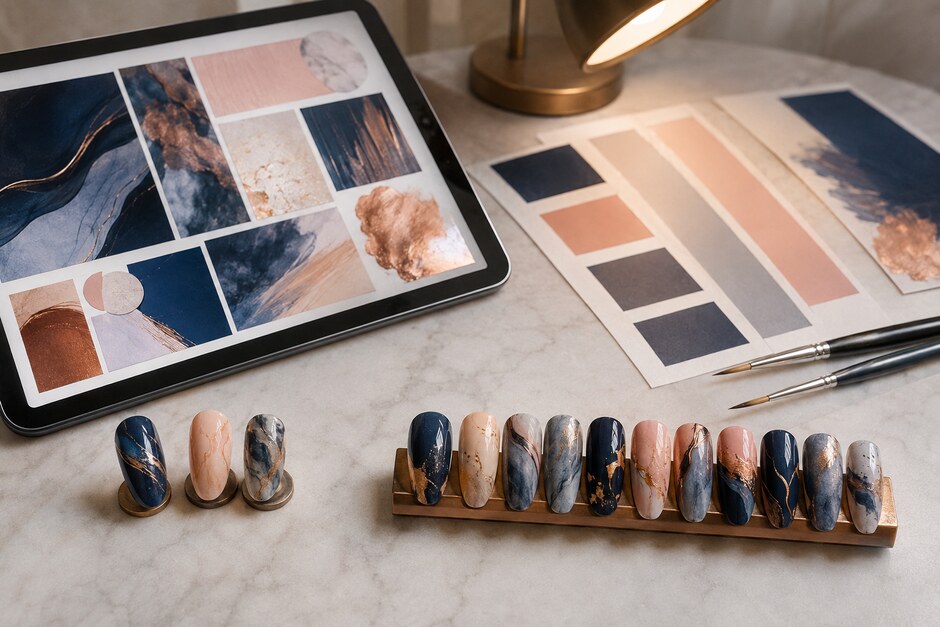
Reduce the palette to light, middle, and dark. Distribute those values across the set before choosing foil, chrome, glitter, or line work. If all dark nails sit on one side, the composition may feel heavy. Repeat a smaller dark accent on the opposite side to create a visual return.
Photograph the arranged tips and view the image in grayscale. Color can hide a weak pattern; value reveals it. The set should remain readable even without hue.
Create rhythm through measured repetition
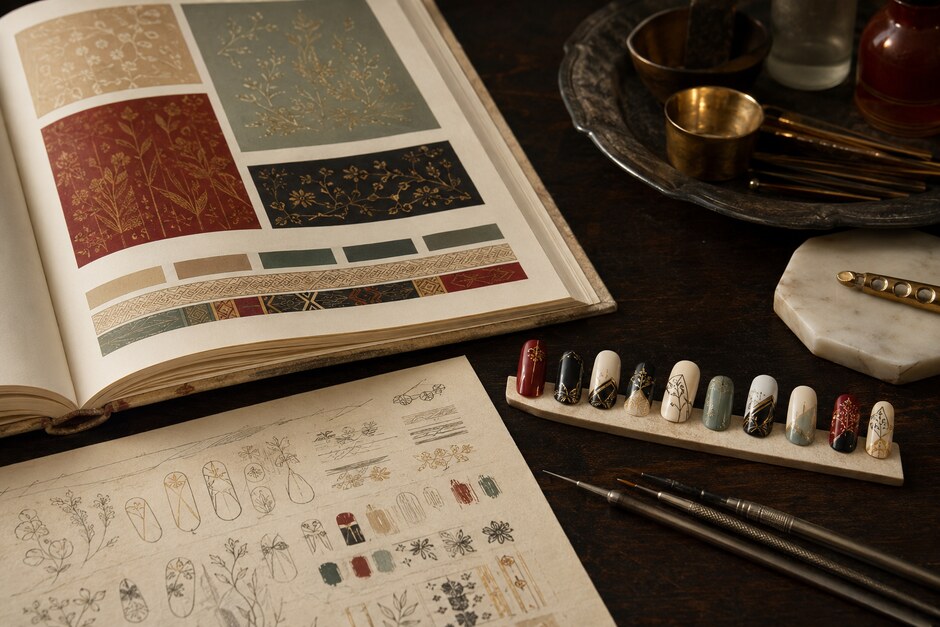
Rhythm begins when an element returns: a crescent, dot, diagonal, metallic line, or empty window. Repeat it enough to establish a rule, then interrupt the rule once or twice. A sequence of small curves can lead toward one larger curve on the focal nail. Repeated side panels can switch direction near the center.
Identical repetition looks manufactured. Random variation looks disconnected. The useful middle ground is a motif with a stable identity and changing scale, crop, direction, or density.
Treat negative space as a material
Unpainted or sheer areas are not unfinished gaps. They separate motifs, reveal the natural shape beneath, and prevent dense details from merging. Design the open area as carefully as the color. A narrow border, off-center window, or clean half-moon can give the eye somewhere to rest.
Check the edges of negative-space shapes. Accidental slivers often appear where two elements nearly meet. Either connect them clearly or create more separation. Ambiguous gaps look like cleanup errors rather than intentional design.
Build a focal pair instead of a focal island
One highly decorated nail surrounded by unrelated minimal nails can feel isolated. A second, quieter echo creates connection. Repeat the focal color, finish, or shape on another finger at reduced intensity. The two accents can be symmetrical, but a slight offset often feels more natural.
Once the focal pair is chosen, remove competition. Reduce contrast on the adjacent nail or replace a complex motif with a single line. Hierarchy is created by difference, not by maximum decoration.
Adapt the motif to curved surfaces
A flat sketch does not show sidewalls or foreshortening. Test the largest motif on a display tip and view it from several angles. Fine lines near the edge may disappear from the front. Wide geometric shapes may look narrower after wrapping around the curve.
Keep important intersections closer to the central visible plane. Let secondary lines travel toward the sides. Scale the design for each nail instead of tracing the same dimensions ten times.
Run three fast composition tests
- Squint test: blur your focus. The overall light-dark rhythm should remain visible.
- Shuffle test: move the tips into a different order. If the design improves immediately, the original distribution needs work.
- Removal test: cover the busiest nail. If the set becomes clearer, simplify that nail rather than adding detail elsewhere.
Composition at nail scale is mostly editing. When value, rhythm, negative space, and hierarchy are settled first, decorative techniques have a structure to support. The result feels cohesive without requiring every finger to repeat the same design.